Blog

  • Stop Naming Your Servers: The Pets vs. Cattle Metaphor That Changed Infrastructure Forever

    Stop Naming Your Servers: The Pets vs. Cattle Metaphor That Changed Infrastructure Forever

    What a farming analogy taught an entire industry about scale, failure, and letting go.

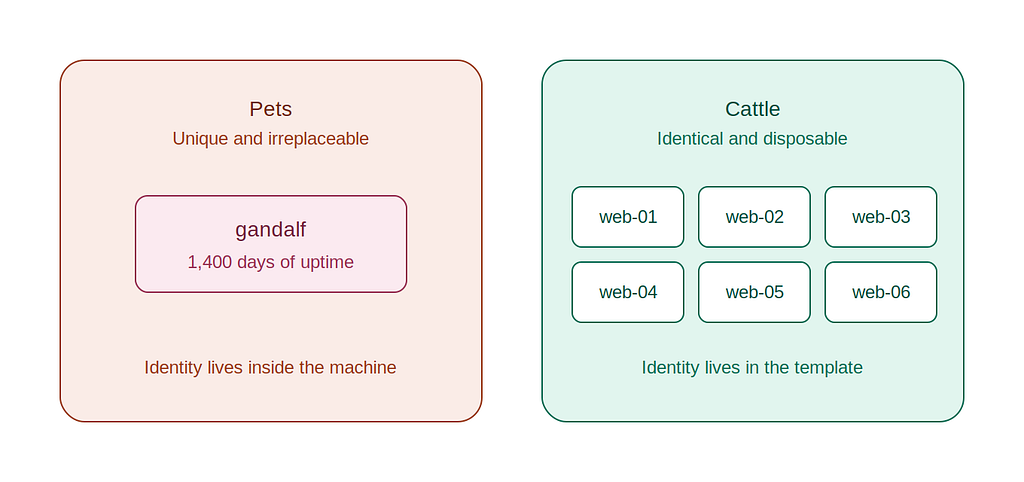
    Somewhere in a server room, there is a machine called gandalf. It has been running for 1,400 days. Nobody remembers exactly what’s installed on it. The one engineer who configured it left two years ago. Everyone is terrified to reboot it.

    If this sounds familiar, you’ve met a pet.

    I ran into the pets vs. cattle metaphor again recently while going through Ardan Labs’ Docker intensive, and it struck me how this one analogy — coined over a decade ago — still explains why containers, Kubernetes, and immutable infrastructure exist at all. If you understand pets vs. cattle, everything else in modern ops is a footnote.

    The metaphor

    The analogy is usually credited to Bill Baker of Microsoft (circa 2012) and popularized by Randy Bias in the cloud computing community. It goes like this:

    Pets are servers you treat like family. They have names — gandalf, zeus, db-master-prod. You raise them by hand. When they get sick, you nurse them back to health, because they are unique and irreplaceable. Losing one is a small tragedy, and recovering takes days of archaeology through undocumented config.

    Cattle are servers you treat like livestock. They have numbers, not names — web-047, node-3a9f. They are born from a template, identical to their siblings. When one gets sick, you don’t call a vet. You cull it and provision a replacement in seconds. No funeral. No archaeology.

    The provocation in the metaphor isn’t about cruelty to animals — it’s about where the identity of your system lives. With pets, identity lives inside the machine: its state, its hand-tuned config, its uptime. With cattle, identity lives outside the machine: in the image, the manifest, the automation that can stamp out a replacement at will.

    Why pets fail at scale

    Pets aren’t wrong, exactly. They’re a rational strategy when you have three servers and one admin. The problems compound with scale:

    Snowflake drift. Every manual SSH session mutates the machine. After a few years, no two “identical” servers are identical, and nobody can say why. The server becomes a snowflake — unique, fragile, and impossible to reproduce.

    Fear-driven operations. When recovery is slow and uncertain, teams stop patching, stop rebooting, stop upgrading. Uptime becomes a vanity metric that actually measures accumulated risk. That 1,400-day uptime isn’t stability — it’s 1,400 days of untested recovery.

    Humans as the bottleneck. Pet care is artisanal. It doesn’t parallelize. Ten times the servers means roughly ten times the toil, and your best engineers become full-time zookeepers.

    The cattle mindset

    Cattle thinking inverts every one of those failure modes:

    1. Servers are disposable; the template is sacred. All effort goes into the image, the Dockerfile, the Helm chart, the Terraform module — never into a running instance.
    2. Recovery is replacement. Mean time to recovery stops being “how fast can our wizard debug this” and becomes “how fast can the orchestrator schedule a new instance.” Usually: seconds.
    3. Configuration is code. If it isn’t in version control, it doesn’t exist. SSH-ing into a production box to “just fix one thing” is treated as an incident, not a workflow.
    4. State is exiled. Application instances are stateless; state lives in databases, object stores, and volumes that are managed deliberately and backed up religiously. This is the hard part, and it’s where most “we’re cloud-native now” stories quietly fall apart.

    Docker: the great cattle-maker

    Here’s where the Ardan Labs course connects the dots nicely. Virtual machines made cattle possible — you could template a VM. But VMs are heavy cattle: gigabytes per head, minutes to boot, an entire OS to feed per instance.

    Containers made cattle cheap. A Docker image is a sealed, versioned, immutable artifact. The container born from it is identical every single time, on your laptop and on node 47 of a production cluster. Containers boot in milliseconds and share the host kernel, so the cost of culling and replacing one approaches zero.

    And once individual animals are cheap, you stop managing animals and start managing the herd. That’s Kubernetes in one sentence: you declare how many head of cattle you want and what breed (replicas + image), and the orchestrator handles births, deaths, and stampedes. A pod dying isn’t a page at 3 a.m. — it’s Tuesday.

    The nuance everyone skips

    Two refinements, because the metaphor is usually presented as more static than it really is:

    Stateful systems were the last holdout — and even they are converting. For years the conventional wisdom said your primary database, your message broker, your ledger would always be pets: too much state, too much risk. The Kubernetes operator pattern is steadily dismantling that. With CloudNativePG, a Postgres instance is genuinely cattle — pods are disposable, failover is automated, and a replacement replica rebuilds itself from the base backup and WAL archive with no human in the loop. Vitess does it for MySQL, Strimzi for Kafka. The cluster’s entire identity is a declarative spec in Git.

    Notice what happened, though: the pet didn’t disappear, it moved up a level. The machines became cattle, and the thing that’s precious is now the data and the spec — the WAL archive, the backup bucket, the manifest. Which was the metaphor’s deepest point all along: cattle thinking isn’t about destroying identity, it’s about relocating it from fragile running instances to durable, reproducible artifacts. Your database servers can die boringly. Your backups had better not.

    Cattle without automation is just neglect. Adopting Docker doesn’t make you cattle-ready. If your “immutable” containers are built by hand, tagged latest, and deployed by SSH, you’ve merely created pets that are harder to inspect. The metaphor is about process discipline — image pipelines, declarative config, GitOps — not about which runtime you use.

    How to spot your pets

    A quick self-audit. You have a pet if:

    • The server has a name a human chose with affection.
    • Rebooting it requires a meeting.
    • “Restore from scratch” has never actually been tested.
    • One specific person is the only one who can fix it.
    • Its uptime is a point of pride.

    The fix isn’t sentimental. Containerize the workload. Move config into the image and the environment. Move state into managed storage. Then do the scary thing on purpose: kill the instance and watch it come back on its own. The first time a server you destroyed resurrects itself in ten seconds, you’ll never want to nurse one again.

    The one-line takeaway

    Build systems where any individual server’s death is boring.

    Pets make you good at heroics. Cattle make heroics unnecessary. And in infrastructure, the absence of heroics is the whole point.


    Stop Naming Your Servers: The Pets vs. Cattle Metaphor That Changed Infrastructure Forever was originally published in Dev Genius on Medium, where people are continuing the conversation by highlighting and responding to this story.